

最近在高强度的 GoGoGoGo,来看看 net/http 这个包
我们主要从“Server” 和 “Client”两个视角出发
阅读源码中,我们发现服务端的 Core 就是围绕着“Handler”和“Server”展开
Server 分析
先写一个最简单的 Web Server
package main

import (
	"fmt"
	"net/http"
)

func helloHandler(w http.ResponseWriter, r *http.Request) {
	query := r.URL.Query()
	name := query.Get("name")
	if name == "" {
		name = "Guest"
	}

	// 写入响应状态码(这里显式写了出来)
	w.WriteHeader(http.StatusOK)
	fmt.Fprintf(w, "Hello, %s!", name)
}

func main() {
	http.HandleFunc("/hello", helloHandler)
	fmt.Println("Listening on port 8080")
	// 启动监听
	if err := http.ListenAndServe(":8080", nil); err != nil {
		panic(err)
	}
}
我们顺藤摸瓜,以这个ListenAndServe为切入点,进入 net/http/server.go 文件
// ListenAndServe listens on the TCP network address addr and then calls
// [Serve] with handler to handle requests on incoming connections.
// Accepted connections are configured to enable TCP keep-alives.
//
// The handler is typically nil, in which case [DefaultServeMux] is used.
//
// ListenAndServe always returns a non-nil error.
func ListenAndServe(addr string, handler Handler) error {
	server := &Server{Addr: addr, Handler: handler}
	return server.ListenAndServe()
}
只是一个包装函数,实例化一个结构体,然后调用 server.ListenAndServe,我们继续跟进
代码如下
// ListenAndServe listens on the TCP network address s.Addr and then
// calls [Serve] to handle requests on incoming connections.
// Accepted connections are configured to enable TCP keep-alives.
//
// If s.Addr is blank, ":http" is used.
//
// ListenAndServe always returns a non-nil error. After [Server.Shutdown] or [Server.Close],
// the returned error is [ErrServerClosed].
func (s *Server) ListenAndServe() error {
    if s.shuttingDown() {
        return ErrServerClosed
    }
    addr := s.Addr
    if addr == "" {
        addr = ":http"
    }
    ln, err := net.Listen("tcp", addr)
    if err != nil {
        return err
    }
    return s.Serve(ln)
}- 调用了底层的
net.Listen("tcp", addr)来开启操作系统的 TCP 端口监听 - 获得
Listener后,把这个它交给Serve方法
这就是网络层向 HTTP 应用层过渡的起点
ok,我们继续跟进
对于func (srv *Server) Serve(l net.Listener) error方法而言
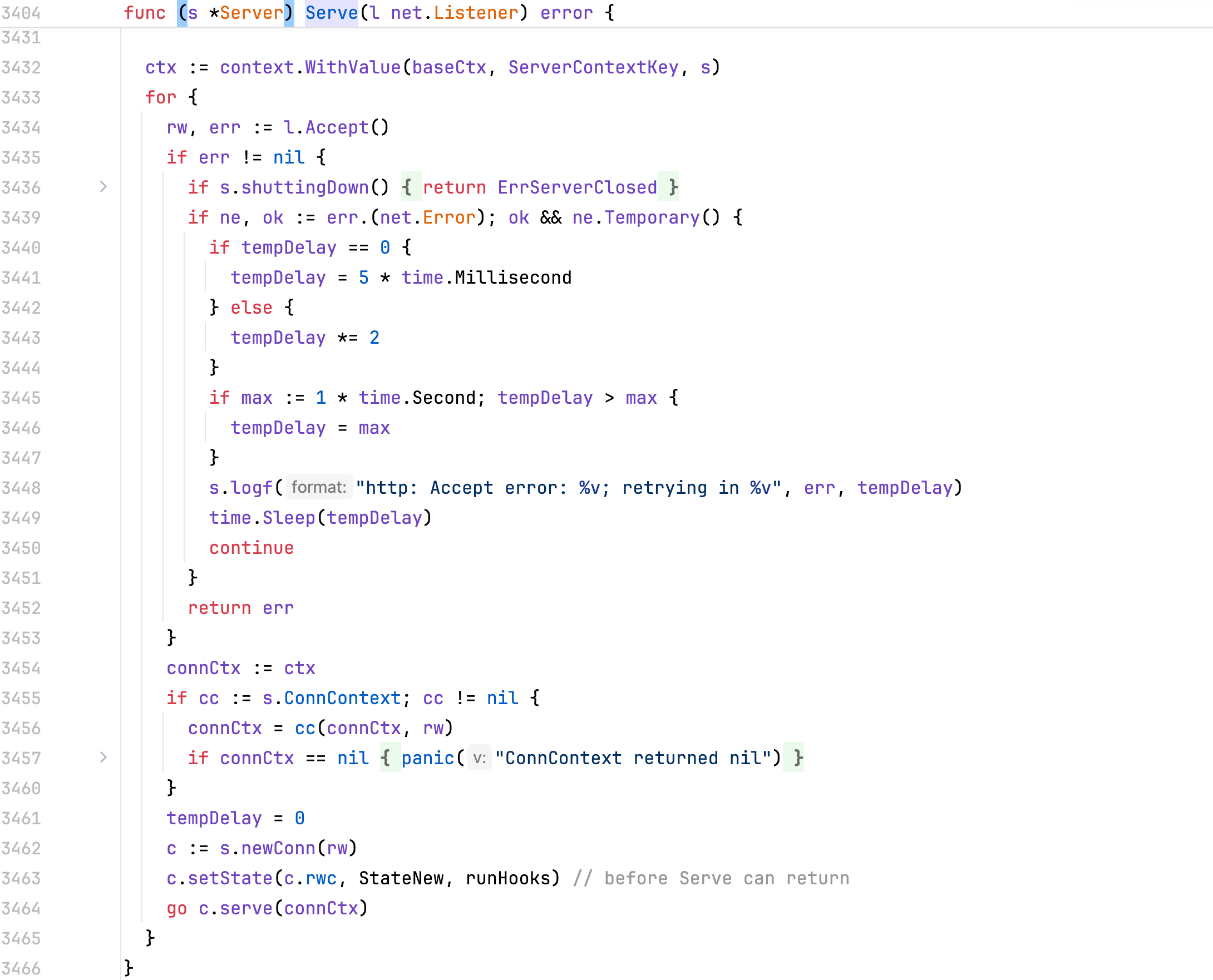
重点关注就是这个无限循环,根据逻辑(忽略错误处理)我们可以简化成
// 简化
for {
    rw, err := l.Accept() // 阻塞等待客户端建立 TCP 连接
    // ... 忽略错误处理 ...

    c := srv.newConn(rw)  // 将原始 TCP 连接包装成 http.conn 结构体
    // ...

    go c.serve(connCtx)   // 划重点:为每一个连接开启一个独立的 Goroutine!
}这个模型其实就揭示了一个秘诀(大家常说的)“每个 TCP 连接一个 Goroutine”,这就是 Go Web 服务的并发模型
继续跟进c.serve,这个函数特别长,包含很多的状态管理和超时控制,我们目前没办法完全理解
关注核心节点,这里聚焦两个
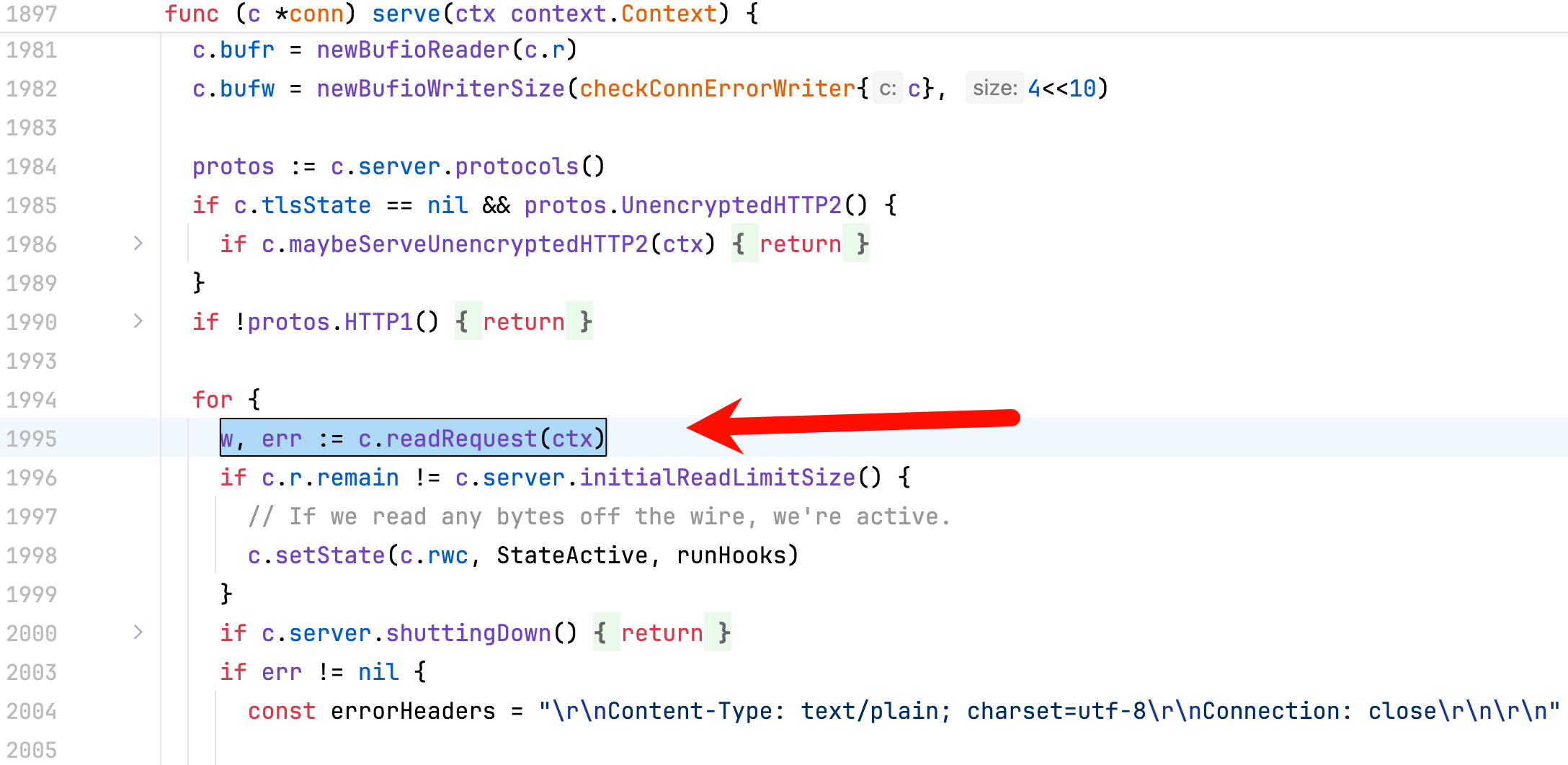
- 读取请求:
**w, err := c.readRequest(ctx)**这里是解析 HTTP 协议的地方。它会把网络流里的字节(比如GET / HTTP/1.1...)解析成你代码里用的*http.Request结构体。
- 转交处理器:
**serverHandler{c.server}.ServeHTTP(w, w.req)**这是最激动人心的一步。底层框架处理完了所有的网络 I/O 和协议解析,现在要把它交回给你写的业务代码了。
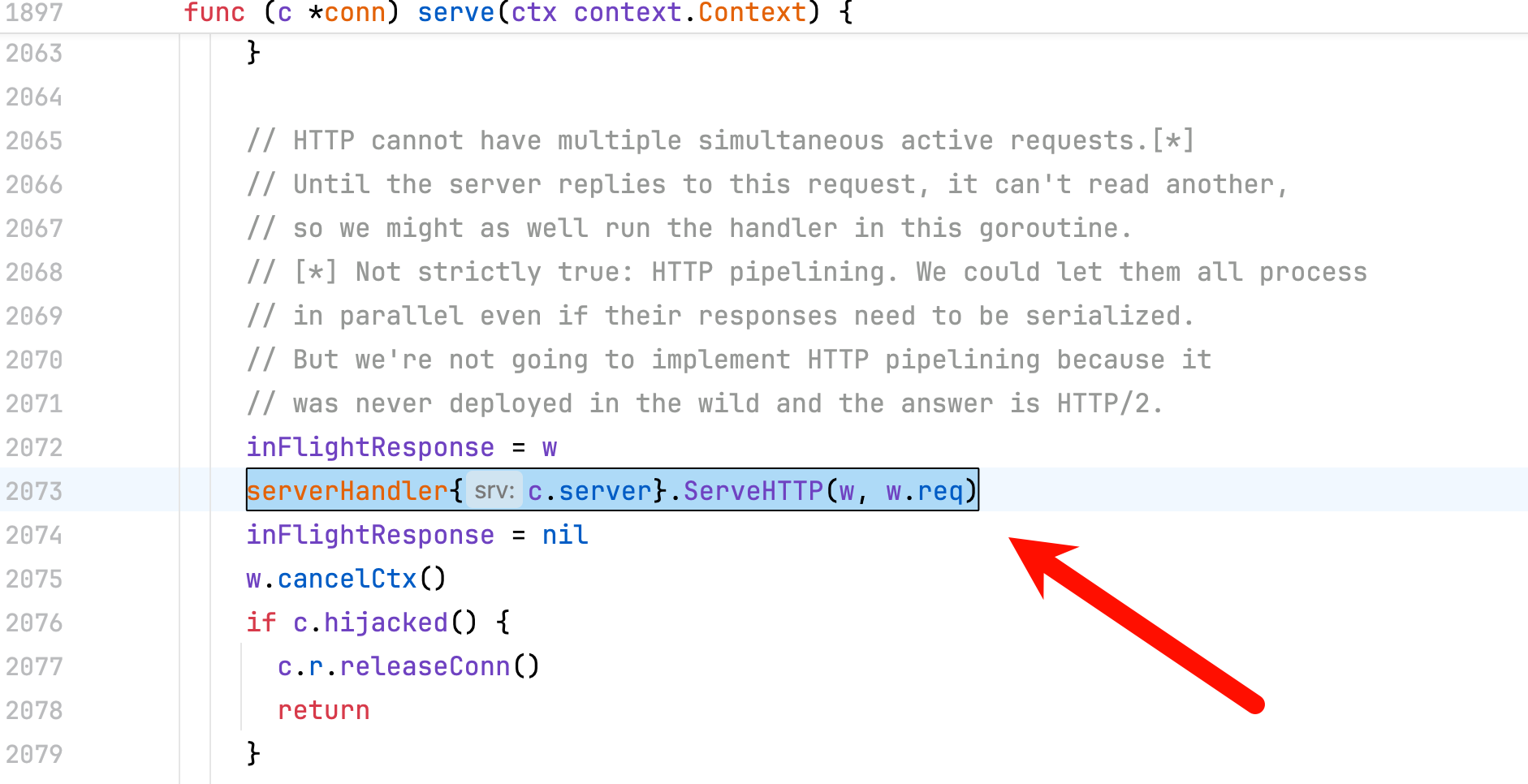
调用 ServeHTTP,我们看一下这段代码写了什么,具体如下
func (sh serverHandler) ServeHTTP(rw ResponseWriter, req *Request) {
	handler := sh.srv.Handler
	if handler == nil {
		handler = DefaultServeMux
	}
	if !sh.srv.DisableGeneralOptionsHandler && req.RequestURI == "*" && req.Method == "OPTIONS" {
		handler = globalOptionsHandler{}
	}

	handler.ServeHTTP(rw, req)
}
我们继续往下看,现在核心转到 ServeMux 多路复用器---> 路由器,解决我一直以来的一个困惑
当一个包含特定 URL(比如 _/_ 或 _/hello_)的请求到来时,Go 是如何精准地找到那个 _helloHandler_ 函数的
__
就像上面那段代码所描述的如果传的Handler 是nil的话就默认用DefaultServeMux
// ServeHTTP dispatches the request to the handler whose
// pattern most closely matches the request URL.
func (mux *ServeMux) ServeHTTP(w ResponseWriter, r *Request) {
	if r.RequestURI == "*" {
		if r.ProtoAtLeast(1, 1) {
			w.Header().Set("Connection", "close")
		}
		w.WriteHeader(StatusBadRequest)
		return
	}
	var h Handler
	if use121 {
		h, _ = mux.mux121.findHandler(r)
	} else {
		h, r.Pattern, r.pat, r.matches = mux.findHandler(r)
	}
	h.ServeHTTP(w, r)
}首先是一个对于*的判断
RequestURI == "*"对应的是 HTTP 里一种特殊形式的请求目标(asterisk-form),典型场景是:OPTIONS *:客户端/代理想询问“这台服务器整体支持哪些方法/能力”,不是针对某个具体路径。
有些坏请求/探测请求也会发
*。
Go 的处理策略是:把它当成 Bad Request (400),并且在 HTTP/1.1+ 时提示关闭连接
其次,有一个跟以前不一样的点,我查了一下这个 mux121 的意思,具体发布在 Go 官方博客
Go 1.22 Release Notes - The Go Programming Language
if use121 {
    // 如果通过 GODEBUG 或 go.mod 指定了老版本行为,走旧版兼容逻辑
		h, _ = mux.mux121.findHandler(r)
	} else {
    // 1.22+的全新路由匹配逻辑
		h, r.Pattern, r.pat, r.matches = mux.findHandler(r)
	}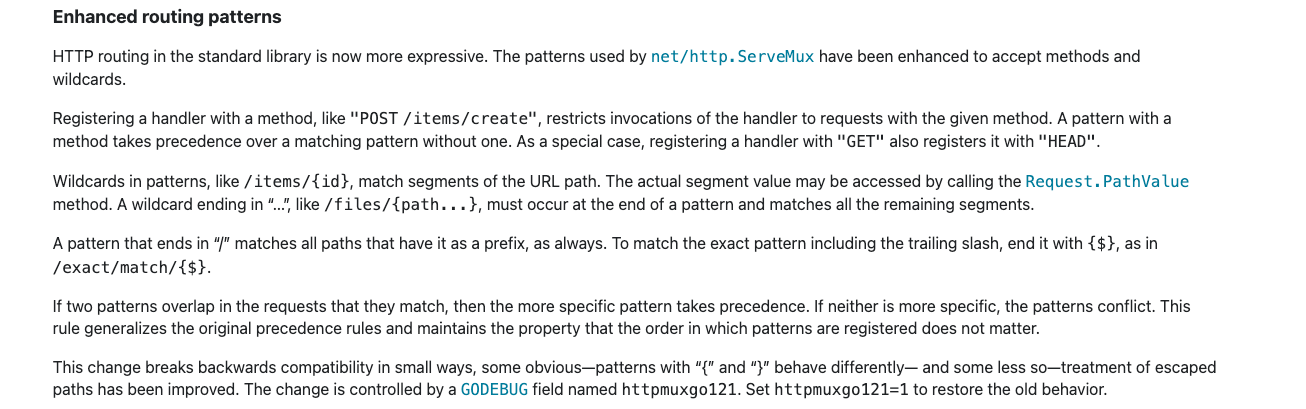
在 Go 1.22 中,官方对
net/http的路由做了一次史诗级的增强(终于原生支持了 HTTP 方法匹配和路径通配符,比如GET /users/{id})
我们这里不过多的阐述更新或者什么版本差异,我们抽象一下具体逻辑,如下
// 1. 寻找对应的处理器
h, _ := mux.Handler(r)
// 2. 执行你的业务逻辑
h.ServeHTTP(w, r)可以看出来ServeMux 本身也实现了 Handler 接口!
为什么这样讲,我们补充阅读时候的两个概念
- Handler 接口
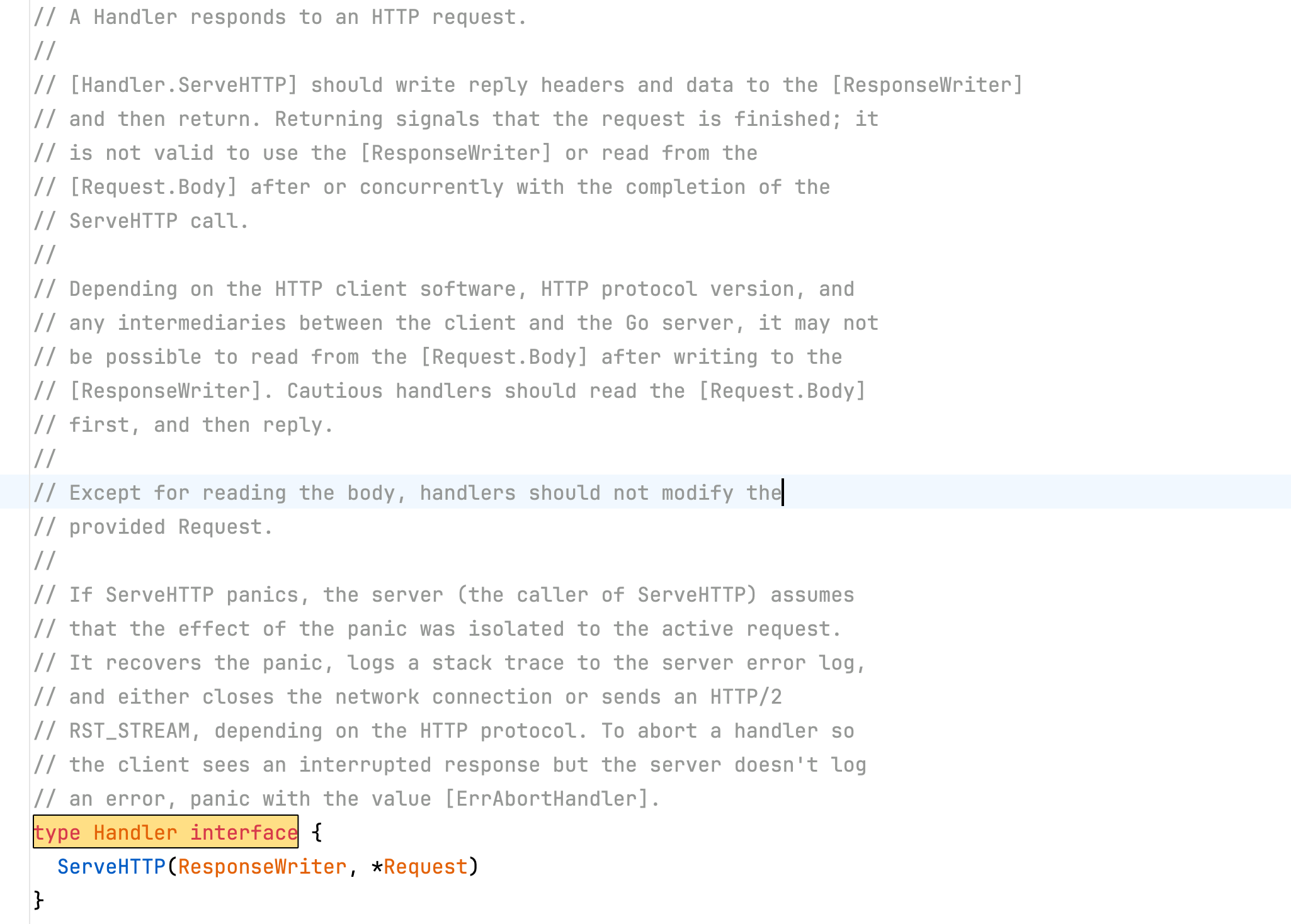
凡是实现了 <font style="color:rgb(31, 35, 40);background-color:rgba(129, 139, 152, 0.12);">ServeHTTP</font> 方法的结构体,都叫 <font style="color:rgb(31, 35, 40);background-color:rgba(129, 139, 152, 0.12);">Handler</font>
- ServeMux,多路复用器,本质就是一张路由表
type ServeMux struct {
	mu     sync.RWMutex
	tree   routingNode
	index  routingIndex
	mux121 serveMux121 // used only when GODEBUG=httpmuxgo121=1
}
它就像一个分发中心,拿到包裹后,找出该给谁,然后让那个人去处理
所以比较妙的一点就是
请求进来
    ↓
net/http 底层: serverHandler.ServeHTTP()
    ↓
如果你没传 Handler,就用 DefaultServeMux
    ↓
DefaultServeMux.ServeHTTP()   ← ServeMux 自己是 Handler
    ↓
查路由表,找到注册的 /hello handler
    ↓
我们的 helloHandler.ServeHTTP() ← 真正执行业务逻辑
nice,现在很清晰有感觉吗
我们顺水推舟,看一下查找过程,追进findHandler(r)
// Handler returns the handler to use for the given request,
// consulting r.Method, r.Host, and r.URL.Path. It always returns
// a non-nil handler. If the path is not in its canonical form, the
// handler will be an internally-generated handler that redirects
// to the canonical path. If the host contains a port, it is ignored
// when matching handlers.
//
// The path and host are used unchanged for CONNECT requests.
//
// Handler also returns the registered pattern that matches the
// request or, in the case of internally-generated redirects,
// the path that will match after following the redirect.
//
// If there is no registered handler that applies to the request,
// Handler returns a “page not found” or “method not supported”
// handler and an empty pattern.
//
// Handler does not modify its argument. In particular, it does not
// populate named path wildcards, so r.PathValue will always return
// the empty string.
func (mux *ServeMux) Handler(r *Request) (h Handler, pattern string) {
	if use121 {
		return mux.mux121.findHandler(r)
	}
	h, p, _, _ := mux.findHandler(r)
	return h, p
}

// findHandler finds a handler for a request.
// If there is a matching handler, it returns it and the pattern that matched.
// Otherwise it returns a Redirect or NotFound handler with the path that would match
// after the redirect.
func (mux *ServeMux) findHandler(r *Request) (h Handler, patStr string, _ *pattern, matches []string) {
	var n *routingNode
	host := r.URL.Host
	escapedPath := r.URL.EscapedPath()
	path := escapedPath
	// CONNECT requests are not canonicalized.
	if r.Method == "CONNECT" {
		// If r.URL.Path is /tree and its handler is not registered,
		// the /tree -> /tree/ redirect applies to CONNECT requests
		// but the path canonicalization does not.
		_, _, u := mux.matchOrRedirect(host, r.Method, path, r.URL)
		if u != nil {
			return RedirectHandler(u.String(), StatusTemporaryRedirect), u.Path, nil, nil
		}
		// Redo the match, this time with r.Host instead of r.URL.Host.
		// Pass a nil URL to skip the trailing-slash redirect logic.
		n, matches, _ = mux.matchOrRedirect(r.Host, r.Method, path, nil)
	} else {
		// All other requests have any port stripped and path cleaned
		// before passing to mux.handler.
		host = stripHostPort(r.Host)
		path = cleanPath(path)

		// If the given path is /tree and its handler is not registered,
		// redirect for /tree/.
		var u *url.URL
		n, matches, u = mux.matchOrRedirect(host, r.Method, path, r.URL)
		if u != nil {
			return RedirectHandler(u.String(), StatusTemporaryRedirect), n.pattern.String(), nil, nil
		}
		if path != escapedPath {
			// Redirect to cleaned path.
			patStr := ""
			if n != nil {
				patStr = n.pattern.String()
			}
			u := &url.URL{Path: path, RawQuery: r.URL.RawQuery}
			return RedirectHandler(u.String(), StatusTemporaryRedirect), patStr, nil, nil
		}
	}
	if n == nil {
		// We didn't find a match with the request method. To distinguish between
		// Not Found and Method Not Allowed, see if there is another pattern that
		// matches except for the method.
		allowedMethods := mux.matchingMethods(host, path)
		if len(allowedMethods) > 0 {
			return HandlerFunc(func(w ResponseWriter, r *Request) {
				w.Header().Set("Allow", strings.Join(allowedMethods, ", "))
				Error(w, StatusText(StatusMethodNotAllowed), StatusMethodNotAllowed)
			}), "", nil, nil
		}
		return NotFoundHandler(), "", nil, nil
	}
	return n.handler, n.pattern.String(), n.pattern, matches
}
很多特殊处理,整体逻辑就是分发
接收请求 -> 找出最匹配的 Handler (h) -> 让这个 Handler 执行自己 (h.ServeHTTP)。不过多学习分析,但是我们可以看一些平时没有注意到的处理
还有一点可以看到如何处理,是404还是405
if n == nil {
    allowedMethods := mux.matchingMethods(host, path)
    if len(allowedMethods) > 0 {
        return HandlerFunc(func(w, r) {
            w.Header().Set("Allow", strings.Join(allowedMethods, ", "))
            Error(w, "...", 405)
        }), "", nil, nil
    }
    return NotFoundHandler(), "", nil, nil
}
先用“当前方法”匹配,失败了并不立刻 404。
它会再查一遍:如果换个 method(比如 GET/POST)能匹配到同一路径吗?”
能:说明路径存在,只是 method 不允许 → __405 Method Not Allowed
不能:才是真 404 Not Found
还有一个就是307,这里说实话我不太清楚 307 是什么条件,查了一下
307 必须保持原 HTTP 方法不变
典型场景:
- 你注册了
/tree/ - 客户端请求
/tree
ServeMux 自动重定向到:
/tree/返回:
307 Temporary Redirect
Location: /tree/
这里代码实现是
n, matches, u = mux.matchOrRedirect(host, r.Method, path, r.URL)
if u != nil {
    return RedirectHandler(u.String(), StatusTemporaryRedirect), n.pattern.String(), nil, nil
}_matchOrRedirect__ 的语义基本是:_
_如果能直接匹配:返回 __n != nil_
如果“差一点就能匹配”,比如缺了尾斜杠 _/tree_ 但注册的是 _/tree/_:
返回一个建议 URL:_u != nil_
由外层统一返回 307 Temporary Redirect
__
Goooood,现在我们就可以看整个生命周期的最后一环---响应是如何写回的
我们在最开始的例子中写了一个HelloHandler,使用了 w http.ResponseWriter 来输出数据
    // 写入响应状态码(这里显式写了出来)
	w.WriteHeader(http.StatusOK)
fmt.Fprintf(w, "Hello, %s!", name)我们尝试去搜索type ResponseWriter interface
type ResponseWriter interface {

	Header() Header
	Write([]byte) (int, error)
	WriteHeader(statusCode int)
}
三个方法
Header() Header:获取并设置响应头。Write([]byte) (int, error):写入响应体数据。WriteHeader(statusCode int):写入 HTTP 状态码
responese 结构体
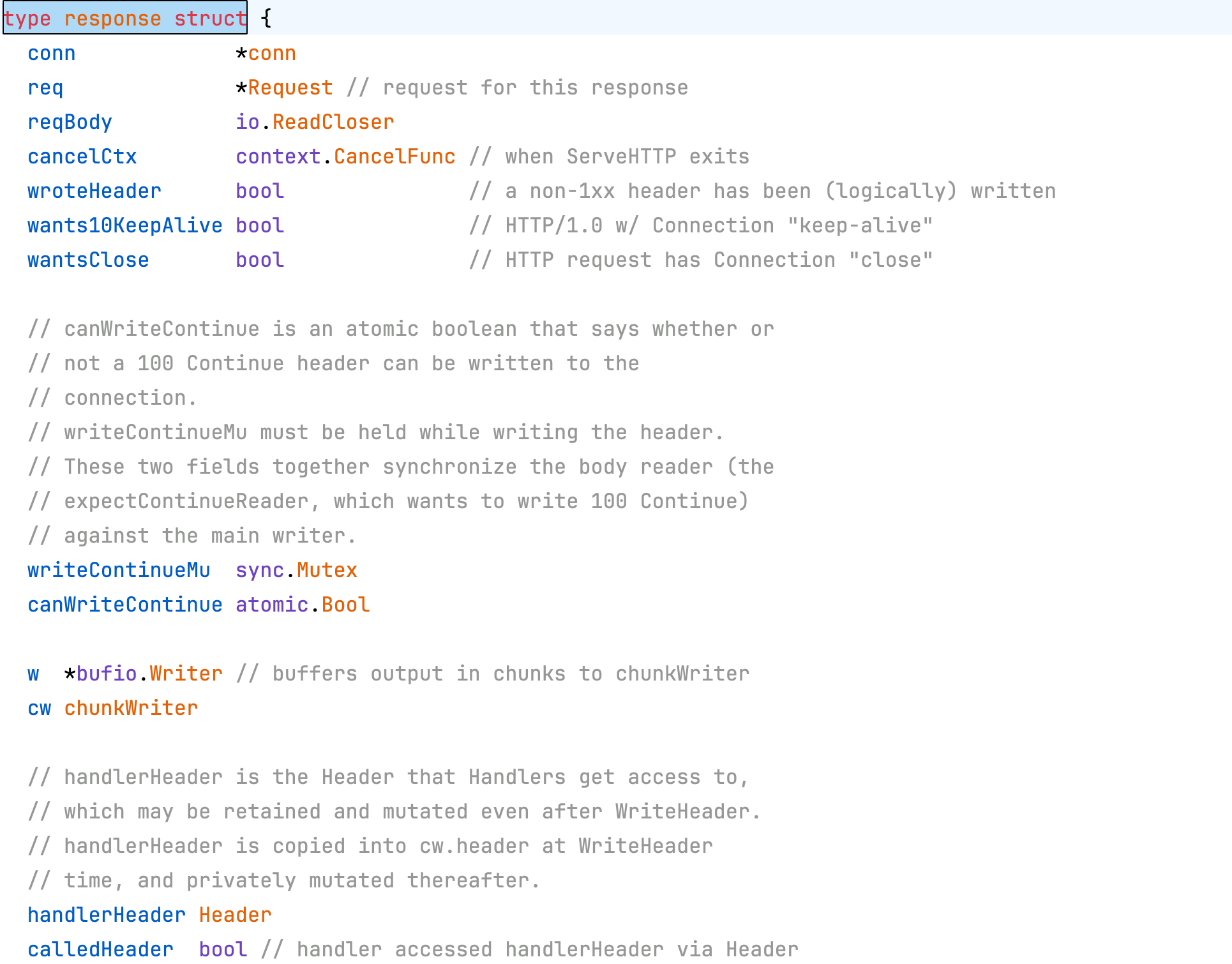
这里关注这个几个量
type response struct {
    conn         *conn          // TCP 连接
    req          *Request       // 本次请求
    wroteHeader  bool           // 状态码写了没?
    w            *bufio.Writer  // 缓冲区
}然后看一个比较有趣的题目“为什么 <font style="color:rgb(31, 35, 40);background-color:rgba(129, 139, 152, 0.12);">Write</font> 之后再 <font style="color:rgb(31, 35, 40);background-color:rgba(129, 139, 152, 0.12);">WriteHeader</font> 会失效?”
可以看一下这里给出的解释
情况一:正常顺序(没问题)
┌─────────────────────────────────────┐
│ w.WriteHeader(404)                  │
│   → wroteHeader = false             │
│   → 写入状态码 404                   │
│   → wroteHeader = true             │
│                                     │
│ w.Write(data)                       │
│   → wroteHeader 已经true         │
│   → 直接写数据,不再写状态码            │
└─────────────────────────────────────┘

情况二:先 Write 再 WriteHeader(出问题)
┌─────────────────────────────────────┐
│ w.Write(data)                       │
│   → wroteHeader == false            │
│   → 自动调用 WriteHeader(200) !!     │
│   → wroteHeader = true              │
│   → 写数据                           │
│                                     │
│ w.WriteHeader(404)  ← 你想改状态码    │
│   → wroteHeader 已经是 true !!       │
│   → 直接 return,忽略这次调用          │
│   → 客户端收到的还是 200,不是 404     │
└─────────────────────────────────────┘
所以我们这里能理解两个点
- 不传 WriteHeader 也没事,
<font style="color:rgb(31, 35, 40);background-color:rgba(129, 139, 152, 0.12);">Write</font>时会自动补<font style="color:rgb(31, 35, 40);background-color:rgba(129, 139, 152, 0.12);">200 OK</font> - Header 必须在 Write 之前设置
应用
标准化输出响应
生成环境中,最常见的就是返回 JOSN 数据
func responseHandler(w http.ResponseWriter, r *http.Request)  {
	respData := map[string]string{
		"status": "success",
		"message": "hello world",
	}
	// 设置 Content-Type 头
	w.Header().Set("Content-Type", "application/json")
	w.WriteHeader(http.StatusCreated)
	json.NewEncoder(w).Encode(respData)
}
中间件 Middleware
中间件的本质:接收一个 Handler,包装一些逻辑后,返回一个新的 Handler
感觉这个设计模式是什么重要的,框架的扩展机制全部建立在中间件之上
在net/http包中,中间价的标准签名是这样的
func Middleware(next http.Handler) http.Handler {
    return http.HandlerFunc(func(w http.ResponseWriter, r *http.Request) {
        // 1. 在这里写:请求到达业务代码【前】的逻辑

        // 2. 将请求传递给下一层(或最终的业务代码)
        next.ServeHTTP(w, r)

        // 3. 在这里写:业务代码执行完毕【后】的逻辑
    })
}
一个很经典的场景,耗时统计中间件
func TimeMiddleware(next http.Handler) http.Handler {
	return http.HandlerFunc(func(w http.ResponseWriter, r *http.Request) {
		// 前置逻辑:记录开始时间
		start := time.Now()

		// 放行:让业务代码去执行
		next.ServeHTTP(w, r)

		// 后置逻辑:计算耗时并打印
		duration := time.Since(start)
		log.Printf("请求 %s %s 耗时: %v\n", r.Method, r.URL.Path, duration)
	})
}
还有一个就是,必用的鉴权
// AuthMiddleware
func AuthMiddleware(next http.Handler) http.Handler {
    return http.HandlerFunc(func(w http.ResponseWriter, r *http.Request) {
        token := r.Header.Get("Authorization")

        // token wrong,out
        if token != "secret-token" {
            http.Error(w, "Unauthorized: 请提供有效的 Token", http.StatusUnauthorized)
            return
        }

        // Token right,pass
        next.ServeHTTP(w, r)
    })
}
评论区
使用 GitHub Discussions 驱动,欢迎留言交流。